
A Buying Guide to Insulated Rolling Doors
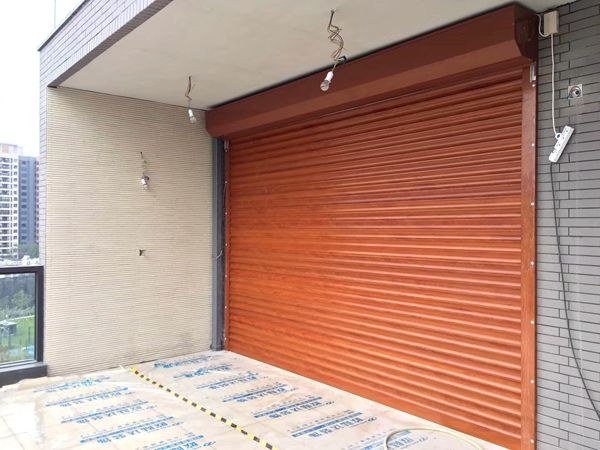
An aluminum roller door with compact overhead housing. Specify the foam-filled slat version when thermal insulation is required.
An insulated rolling door, also called an insulated roller door, combines an overhead storage arrangement with a curtain designed to resist heat transfer. For a heated warehouse, air-conditioned workshop or commercial garage, it can provide useful thermal separation while keeping much of the ceiling area available for lighting, services and storage.
However, two doors described as “insulated” can behave very differently. The curtain construction, slat joints, perimeter seals, operating speed and installation details all influence the result. Start with the opening’s temperature conditions and traffic pattern, then compare the complete door system.
Conventional Insulated Rolling Doors and Related Systems
Industrial insulated rolling door, industrial insulated roller door and thermally insulated rolling shutter are overlapping product descriptions. The terminology alone does not establish the mechanism, insulation level or operating duty. The comparison below covers a conventional metal coiling door and two related high-speed systems.
| Door system | Construction and movement | Useful application | Main selection question |
|---|---|---|---|
| Conventional insulated metal rolling door | Interconnected insulated slats coil around a barrel above the opening | Exterior warehouse, factory and commercial garage entrances | Does the complete assembly provide the required insulation, sealing and cycle capacity? |
| Insulated rigid high-speed spiral door | Rigid insulated panels or slats travel through a guided spiral arrangement | Busy industrial entrances requiring fast access and rigid closure | Is the selected mechanism designed for the required traffic, clearances and wind exposure? |
| Specialist insulated fabric roll-up door | A flexible, purpose-designed thermal curtain rolls overhead | Selected refrigerated passages and cold-chain traffic routes | Is the complete system suitable for the temperatures, humidity and frost conditions? |
A conventional rolling shutter coils its curtain around a barrel. A guided spiral design can keep adjacent rigid slats separated during storage; the exact arrangement depends on the model. These are different mechanisms with different space and maintenance requirements.
An insulated overhead door may instead be a sectional door with large hinged sections running along tracks. Confirm the construction before comparing quotations. Specialized insulated fabric doors also exist, but an ordinary PVC curtain or two layers of standard PVC should not be assumed equivalent to a freezer door.
Materials and Curtain Construction
Metal skins and foam-filled slats
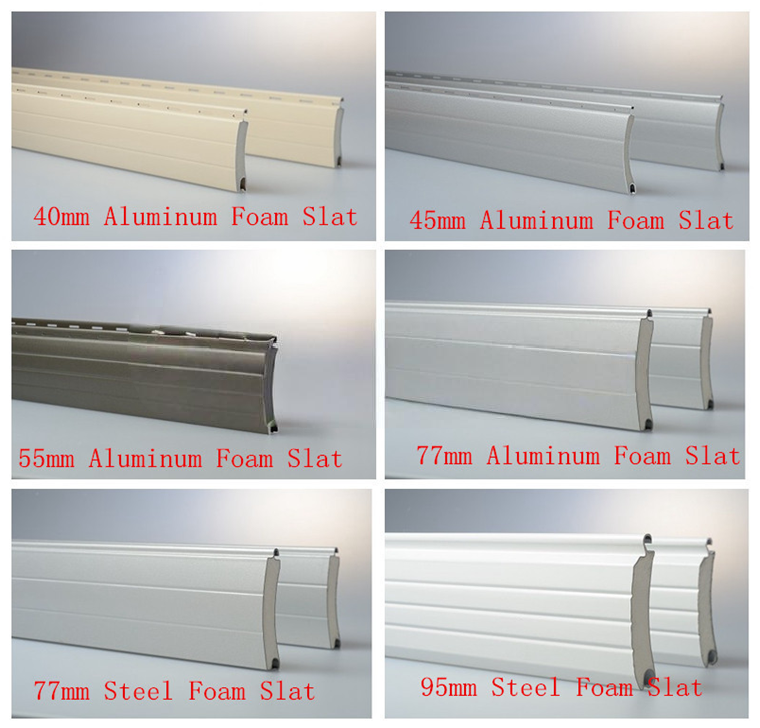
A common PU insulated door uses double-skin metal slats with polyurethane foam between the faces. “Polyurethane insulated door” describes the insulation material; it does not specify the metal thickness, joint design or whole-door thermal performance.
| Material or construction | Practical considerations |
|---|---|
| Galvanized or coated steel skins with PU foam | Consider the slat profile, coating, reinforcement and total curtain weight. Steel material alone does not establish a wind or security rating. |
| Aluminum skins with PU foam | Useful where appearance and material weight matter. Confirm alloy, profile, finish and guides for the opening and environment. |
| Stainless steel components or skins | Consider where cleaning conditions or corrosion exposure justify them. Specify the grade and cleaning compatibility. |
| Specialist insulated flexible curtain | May combine coated fabric, flexible insulating foam and protective layers. Its temperature suitability must apply to the complete curtain and operating system. |
PU PIR and EPS are not interchangeable specifications
PIR—polyisocyanurate—and EPS—expanded polystyrene—are other insulation materials. Their availability in building panels does not establish suitability for a particular coiling slat. EPS is also used in commercial sectional doors, which have a different construction.
For a rolling-door quotation, request the actual core material, thickness, slat cross-section and relevant performance documentation. A hollow double-skin profile should not be presented as the same specification as a foam-filled one. Anjie Door’s insulated aluminum roll-up garage door lists both PU-filled and hollow options, so identify the required version clearly.
How to Compare Thermal Insulation Properly
Check whole-door U-value
A low U-value means less heat transmission under the stated assessment conditions. Compare whole-door results using compatible units, methods and configurations.
An insulation-core or door-section R-value describes a different scope. Taking the reciprocal of a section R-value does not produce the installed door assembly’s U-value. DASMA explicitly distinguishes these measures.
Ask whether the quoted value includes the relevant curtain joints, perimeter components and glazing. Added windows or other options can change the result.
Confirm where the thermal break is located
A thermal break interrupts a conductive path with a less conductive component. Depending on the design, it may be incorporated in slats, guides or other perimeter details. Foam inside a metal slat does not, by itself, confirm a complete thermal break. Ask for the cross-section showing what separates the warm and cold sides.
Evaluate air leakage separately
Heat can pass through the closed door, while air can also leak around or between its components. Check the side guides, curtain joints, top seal and bottom seal. Ask for documented air-leakage performance when the project requires it; an insulation rating alone does not describe sealing performance.
Include the opening cycle
At a busy entrance, total open time also matters. Opening speed, closing delay, activation distance and traffic management affect how long the building is exposed. Assess both closed-door performance and operation when estimating energy use.
No fixed energy-saving percentage can be promised without the site temperatures, opening dimensions, traffic data and baseline door performance.
Which Door Suits Each Application
The following are starting points for selection, subject to the actual project conditions.
| Application | Option to evaluate | Details that deserve attention |
|---|---|---|
| Heated warehouse or factory exterior | Insulated metal rolling door; insulated spiral door where traffic justifies it | Whole-door U-value, perimeter seals, wind exposure and opening frequency |
| Workshop insulated door | Conventional insulated roller door or suitable high-speed rigid model | Vehicle clearance, operator duty and drafts near workstations |
| Commercial garage or service bay | PU-filled aluminum or steel rolling door | Coil space, side room, weather sealing and window configuration |
| Food processing room door | Door selected for the temperature zone and cleaning regime | Cleanability, moisture, corrosion exposure and traffic controls |
| Refrigerated warehouse passage | Purpose-designed insulated fabric door or another cold-room door system | Temperature differential, humidity, condensation, frost management and sealing |
For frequent factory traffic, review Anjie Door’s industrial high-speed spiral door. For refrigerated passages, explore the insulated PVC high-speed roller door for cold-storage applications and confirm its project-specific configuration.
A motor or curtain rated to operate at a low temperature does not, on its own, establish that the door will provide the required freezer-room thermal barrier.
Information to Include in an Inquiry
Give the supplier enough information to propose a configuration:
- Opening and clearances: structural width and height, required clear passage, headroom, side room, mounting surface and photographs.
- Temperature conditions: normal and extreme temperatures on both sides, humidity where known, and indoor or outdoor exposure.
- Operating duty: cycles per hour and day, peak traffic, vehicle type and approximate hold-open time.
- Project requirements: insulation target, wind conditions, cleaning regime, power supply, controls and any required documentation.
- Installation and service: location, available technical support, maintenance access and spare-parts expectations.
Request an installation drawing showing the full equipment envelope, coil or spiral housing, motor position, fixing points and final clear width and height. A compact overhead arrangement still needs adequate space above and beside the opening.
Frequently Asked Questions
Is an electric insulated roller door automatically a high-speed door?
No. Motorized operation does not establish opening speed or high-cycle capacity. Compare the operator duty, curtain mechanism and intended use.
Are thicker insulated slats always better?
Thickness can contribute to thermal resistance, but joints, thermal bridges, seals and installation remain relevant. Use documented assembly performance to compare completed doors.
Can I add insulation to an existing rolling shutter?
Request an assessment from the door manufacturer. Added material can change curtain weight, coiling geometry and operating requirements. Specify a compatible engineered solution before modifying the door.
Find an Insulated Rolling Door for Your Project
Explore Anjie Door’s product range to compare aluminum rolling shutters, rigid high-speed spiral doors and cold-storage systems. Send your opening dimensions, temperatures, traffic frequency, installation photographs, quantity and destination country to request a suitable configuration and quotation.
Final dimensions, thermal specifications, wind performance and safety equipment should be confirmed for the selected model and site.
Related Reading
Insulated Aluminum Roll-Up Garage Door with WindowsVIEW PRODUCTS