
How to Choose Cold Storage Insulated Doors
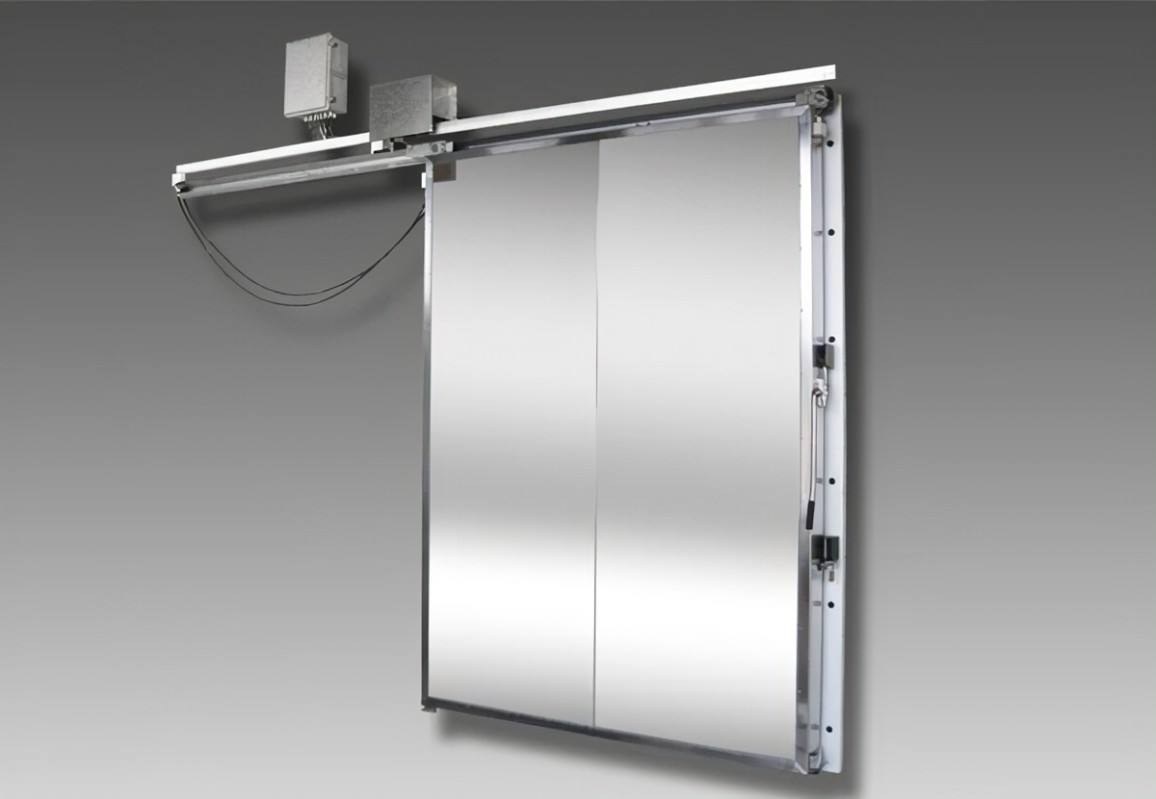
A sliding cold-room door with a rigid leaf, overhead track and operating hardware.
A cold storage insulated door, also called a cold room insulated door, helps separate a refrigerated space from a warmer area while allowing people and goods to pass. Choosing one involves more than selecting a thick panel: the opening method, seals, frame, insulation, traffic controls and installation must work together.
A small food preparation cooler and a busy frozen-food warehouse present different conditions. Start with the temperatures and humidity on both sides of the opening, then match the door to the traffic route and available space. Anjie Door’s cold storage door range includes product options for refrigerated storage and handling projects.
Compare the Main Types of Cold Room Insulated Doors
| Door type | Suitable applications | Main selection considerations |
|---|---|---|
| Hinged or insulated swing door | Personnel entrances, walk-in coolers and smaller storage rooms | Allow a clear swing area; check closing effort, gasket compression and inside release. |
| Horizontal sliding insulated door | Pallet access and larger refrigerated warehouse openings | Reserve side space for the leaf and track; choose manual or automatic operation around traffic needs. |
| Vertical-lift insulated door | Openings with limited side space or closely spaced adjacent entrances | Check clear height, support structure, overhead equipment and maintenance access. |
| Specialist high-speed insulated cold-storage door | Frequent movements between refrigerated zones | Verify the complete door’s temperature suitability, insulation, sealing, frost-control design and safety system. |
Hinged and swing doors
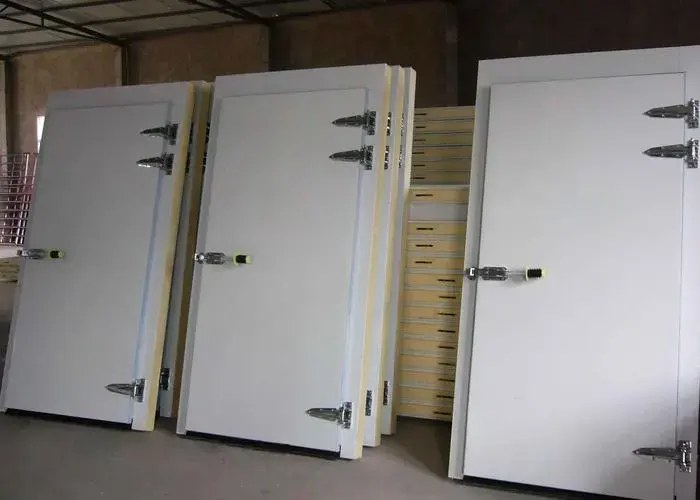
A hinged insulated swing door is a practical starting point for compact cold rooms used by staff carrying small loads. Its leaf opens into a defined area, so confirm that shelves, carts and people will not obstruct its movement. Review Anjie Door’s cold room hinged door for this type of opening.
A lightly insulated double-action traffic door has a different function. Do not assume that its flexible edges or easy movement provide the same enclosure performance as a dedicated cold-room door.
Sliding and vertical-lift doors
An insulated sliding industrial door moves sideways, keeping a broad swing arc out of the traffic route. Automatic operation can be useful for regular forklift movements or large panels. Explore the cold room sliding door and automatic cold room sliding door options.
Where adjacent walls cannot accommodate a sliding leaf, a specialist vertical-lift design may be worth evaluating. Manufacturers offer these for cooler and freezer applications, but they need suitable overhead clearance and structural support.
Specialist high-speed cold-storage doors
Frequent traffic can make time spent open a major selection factor. Purpose-designed high-speed freezer doors combine rapid operation with insulated curtains, sealing and controls intended for refrigerated service. Their suitability depends on the actual design and operating conditions.
An ordinary single-layer PVC high-speed door should not be treated as the primary insulated barrier for a freezer simply because its curtain is flexible at low temperatures. A two-door arrangement may be considered: a rigid insulated door for extended closure and a specialist fast door for busy operating periods. Confirm that the proposed combination suits the site.
Understand What Determines Thermal Performance
Compare the complete door
The U-value describes thermal transmittance: a lower value indicates less heat passing through the assessed assembly under the stated conditions. Ask whether a quoted figure covers the complete door or only the centre of its panel. Request the test or calculation method, reference size, frame configuration and any windows included.
A panel-only R-value does not describe the complete door’s thermal performance. Taking its reciprocal does not produce the whole-door U-value, because the assessment boundaries differ. A purchasing specification should identify exactly what must achieve the target.
Inspect seals and thermal bridges
Panel insulation controls only part of the heat transfer. Check the top, side and bottom seals; frame joints; the threshold; and the connection to the cold-room wall. A damaged gasket or an uneven closing surface can undermine an otherwise well-insulated leaf.
A thermal break interrupts a conductive path through the structure. Use this description only when the selected design includes that feature, and ask where it is located. An insulated core alone does not demonstrate that the frame and edges are thermally broken.
Include moisture and door-open time
Warm, humid air entering a refrigerated room brings both heat and moisture. Condensation and frost can develop on cold surfaces, creating additional operational problems. ASHRAE identifies moisture infiltration, door positioning, sealing and safe traffic flow as important refrigerated-facility design considerations.
For a busy refrigerated warehouse door, assess opening duration and controls alongside insulation. Door interlocks, an appropriately designed vestibule or changes to traffic routing may be useful, depending on the facility. Ask the refrigeration designer to consider the complete opening arrangement.
Compare Insulation Materials and Door Surfaces
Many rigid cold-room doors use sandwich-panel construction, with protective faces enclosing an insulating core. The core, faces, perimeter structure and joints all affect the finished assembly.
| Material or construction | Role in the door | What buyers should check |
|---|---|---|
| PU/PUR polyurethane foam | An insulating core used in many rigid cold-room door designs | Declared thermal performance, manufacturing quality, moisture protection and complete-door suitability. |
| PIR polyisocyanurate foam | A rigid core used in temperature-controlled panel systems; confirm availability in the door model | Availability in the actual door model, declared conductivity and relevant assembly test documentation. |
| EPS expanded polystyrene | A rigid insulation option used in some laminated panel constructions | Required thickness and declared performance; equal thickness does not mean equal insulation. |
| Coated steel faces | Protect the panel and provide a finished surface | Coating suitability, resistance to the cleaning regime and treatment of damaged edges. |
| Stainless steel faces | A surface option for demanding cleaning and corrosion conditions | Steel grade, surface finish, joint design and compatibility with cleaning chemicals. |
A PU insulated door and a polyurethane insulated door usually describe the same core material family. PU, PIR and EPS should be compared using product data, rather than treating the material name as a performance rating.
Stainless steel forms the protective facing; the insulating core sits between the faces. Food processing areas may be ambient, chilled or frozen. For a food processing room door, match the actual temperature zone and assess cleanability across the gaskets, handles, joints and exposed hardware. Anjie Door’s sliding-door product page lists PU insulation and stainless steel configurations; confirm the exact specification for the quotation.
An insulation material’s fire characteristics do not automatically make the completed door fire-rated. Where fire separation is required, obtain documentation for the relevant tested door assembly.
Match the Door to the Application
For a restaurant, supermarket or small walk-in cooler, begin with access width, daily deliveries, swing clearance and easy cleaning. A hinged insulated door may meet the operational need without automation.
For a meat, seafood or dairy facility, review cleaning methods, corrosion exposure, pallet movements and segregation between temperature zones. A stainless steel sliding door may be an appropriate candidate, subject to the actual hygiene and temperature requirements.
For a frozen-food distribution centre, examine peak traffic as well as overnight closure. Compare rigid sliding doors, specialist high-speed insulated systems and combined arrangements. Investigate recurring frost before selecting replacements: damaged seals, extended opening periods and humid air from adjacent areas may all require attention.
For a walk-in freezer, review freezer-specific configurations in Anjie Door’s cold storage door range. Confirm the design temperature and anti-frost provisions for the complete installation.
Confirm Installation and Safety Before Ordering
Freezer applications may require heating at the frame, gasket contact area or threshold. The location and control of heating depend on the door design, temperature, humidity and opening frequency; these are not universal requirements for every chilled-room door.
Specify an effective inside safety release wherever personnel could become trapped. For powered doors, agree obstruction detection and reversal, emergency operation and power-failure arrangements through the site risk assessment and applicable requirements. Include these items in commissioning and maintenance checks.
Before ordering, provide:
- Clear opening width and height, wall construction, and available side and overhead space.
- Required room temperature and the temperature and humidity on the opposite side.
- Traffic type, peak opening frequency, typical open time and preferred operation.
- Cleaning requirements, surface preference, power supply and project location.
- Installation photographs and any required thermal-performance documentation.
Ask Anjie Door to recommend a configuration from its industrial door products. Confirm the final dimensions, materials, sealing, safety devices and operating conditions in the approved project specification.
Related Reading
Cold Room Sliding DoorVIEW PRODUCTS