
How to Choose a Door Between a 23°C Warehouse and a 30°C Goods Corridor
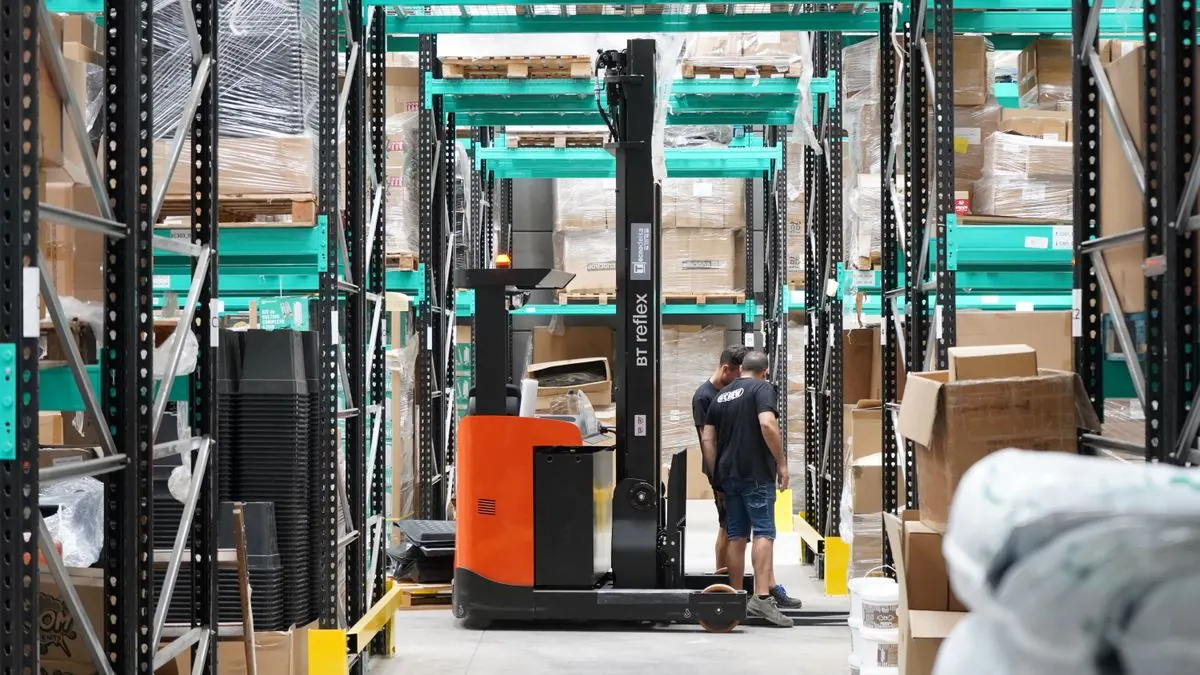
Illustrative stock photo of warehouse traffic. It does not show the quoted project or establish a controlled temperature. Photo: GB The Green Brand / Pexels.
Which door should separate a temperature-controlled warehouse from a warmer goods corridor?
Consider a project with a warehouse maintained at a target temperature of 23°C, an adjacent corridor at 30°C, and approximately 10 movements per hour involving both forklifts and hand trolleys. The existing opening measures approximately 2395 mm wide × 2400 mm high.
For these requirements, our first option to evaluate would be a well-sealed, self-repairing PVC high-speed roll-up door. We would request a standard PVC curtain quotation and a separate quotation for a compatible multilayer insulated curtain.
However, choosing the right warehouse door requires more than comparing curtain thickness. The decision should also account for the permitted temperature variation, actual door-open time, sealing, traffic safety and the clear opening available after installation.
This guide explains how to compare the options using the stated project requirements, rather than assuming that every temperature-controlled warehouse needs a cold room door.
The Project Requirements
| Project condition | Stated requirement |
|---|---|
| Warehouse temperature | 23°C target |
| Goods corridor temperature | 30°C |
| Temperature difference | 7°C |
| Traffic frequency | Approximately 10 movements per hour |
| Traffic type | Forklifts and hand trolleys |
| Existing opening | Approximately 2395 mm wide × 2400 mm high |
| Installed clear opening | To be confirmed through the installation drawing |
The missing information is also important. Before selecting the final configuration, confirm the acceptable temperature range, daily operating hours, busiest traffic period, humidity conditions and available mounting space.
A warehouse with a 23°C target and some permitted fluctuation may justify a different investment from one with a tightly controlled storage specification.
Understand What the Door Must Control
A door separating these two zones should be assessed in three operating conditions.
When open, it allows air exchange between the warehouse and corridor. Suitable automatic operation can reduce unnecessary open time.
When closed but poorly sealed, gaps around the curtain, guides, bottom edge or frame connections can still allow unwanted air movement.
When closed and well sealed, heat can still pass through the curtain and other parts of the assembly. This is where the thermal performance of the selected construction becomes relevant. These are separate considerations: opening speed does not replace insulation, and insulation does not replace effective sealing.
For this project, both sides are above freezing. The stated temperatures alone do not justify specifying a freezer-door package. Start with the actual environmental-control requirement and ask what additional performance each proposed option provides.
For a broader explanation of these selection factors, see Anjie Door’s Energy Saving Door Solutions.
Option 1: A Sealed PVC Self-Repairing High-Speed Door
A standard PVC curtain configuration is a sensible starting point for comparison when the priorities are automatic access, practical internal separation and efficient goods movement.
Anjie Door’s Industrial Self-Repairing Zipper PVC High-Speed Door is a relevant product to review. Its published applications include logistics passages and forklift traffic areas, and its zipper-edge design is intended to help the curtain return to its guide system after a recoverable displacement.
For the 23°C warehouse, ask the supplier to explain the proposed side, top and bottom sealing arrangements. Also request confirmation of automatic opening, closing controls, safety devices and the installed clear dimensions.
Do not select the standard curtain simply because the temperature difference is only 7°C. Instead, use it as the baseline against which an insulated alternative can be evaluated.
Our recommendation: retain this option when it satisfies the agreed temperature-control requirement and offers the required traffic handling, safety and installation fit.
Option 2: A Multilayer Insulated PVC High-Speed Door
An insulated curtain deserves closer evaluation when the warehouse operates for long hours, the acceptable temperature variation is narrow, or the door remains closed for substantial periods between movements.
A relevant starting point is Anjie Door’s PVC High-Speed Roller Shutter Door with Thermal Insulation. The product page lists insulated curtain material among the available configurations and states that the thermal configuration depends on the selected model and project requirements.
Before choosing this option, request the proposed curtain construction, including the layers, insulating material and total thickness. Ask what thermal data is available and whether it applies to the curtain material or the complete door assembly.
Also confirm whether the insulated configuration supports the requested self-repairing guide system and viewing window. These features should be checked together rather than assumed to be interchangeable across all models.
“Insulated” and “self-repairing” describe different requirements. The purchase specification should confirm both when both are needed.
Our recommendation is to compare the insulated option against the standard curtain with equivalent safety and operating controls. That makes the additional cost and technical differences easier to evaluate.
Why Ten Movements per Hour Still Justifies Comparing Insulation
Ten movements per hour works out to an average of one movement every six minutes. It does not describe how long the door remains open or whether several movements occur together.
For illustration, assume that every movement triggers a separate cycle lasting 20 seconds from the start of opening until the door closes fully. Ten such cycles would occupy 200 seconds, or approximately 3.3 minutes, per hour.
Under that assumption, the door would remain fully closed for approximately 56.7 minutes.
This is only a timing example. It is not an estimate of heat loss, electricity consumption or energy savings. It shows why it would be premature to ignore closed-door performance merely because the opening serves a logistics route.
The quotation should therefore address both operating efficiency and closed-door performance. Ask about actual opening and closing times, adjustable hold-open delay, perimeter sealing and the proposed curtain construction.
Also confirm whether “10 movements per hour” means ten one-way passages, ten round trips, or ten opening cycles. The final operating specification should reflect the busiest period, not just the hourly average.
When Should an Insulated Sliding Door Be Considered?
An automatic insulated sliding door is worth comparing when closed-door insulation is a higher priority and the wall beside the opening can accommodate the sliding leaf.
Anjie Door’s Automatic Cold Room Sliding Door offers motorized horizontal movement and insulated panel construction. It is presented for temperature-controlled facilities and logistics applications.
For this particular warehouse, we would keep it as an alternative rather than automatically choosing it because the room is temperature controlled.
Ask the supplier to confirm the lateral space required, operating cycle, sealing arrangement and controls for both forklifts and hand trolleys. Compare those requirements with the available space and workflow.
A sliding door should not be rejected simply because it uses horizontal movement, but its suitability must be established from the proposed configuration.
Is an Insulated Sectional Door Another Option?
An insulated sectional door is another candidate when a rigid panel construction is preferred and the building can accommodate the required track arrangement.
The Insulated Galvanized Steel Sectional Door combines steel panels with PU insulation and offers different lift arrangements according to the building structure.
For a 2395 × 2400 mm internal opening, we would ask the supplier to demonstrate a suitable installation layout and confirm that the selected operator and door assembly can handle the required duty.
This option becomes more relevant when the project calls for rigid panels in addition to thermal separation. Without that additional requirement, our initial comparison would remain focused on standard and insulated PVC high-speed configurations.
Our Recommendation for This Warehouse
For the stated combination of a 23°C warehouse, 30°C corridor and mixed forklift and hand-trolley traffic, we recommend the following procurement approach.
First, obtain a quotation for a sealed, self-repairing PVC high-speed door as the baseline.
Second, request a compatible multilayer insulated curtain alternative, with the same requested activation and safety functions. Ask the supplier to identify any changes to the guides, motor, viewing window or installation envelope.
Third, compare an automatic insulated sliding door only where the thermal requirement or available layout makes it a credible alternative.
Do not approve the order solely from the existing opening dimensions. A 2395 × 2400 mm opening does not automatically mean that the finished installation will retain 2395 × 2400 mm of usable passage.
The supplier should provide the equipment dimensions, required mounting and service spaces, and the final clear width and height for the proposed configuration.
Frequently Asked Questions
Does a 23°C warehouse need a cold room door?
Not automatically. For this project, the temperature difference alone does not establish that requirement. Our initial recommendation is to compare sealed PVC high-speed configurations, then assess whether the specified temperature tolerance justifies an insulated curtain or a rigid insulated alternative.
Will an insulated high-speed door guarantee a constant 23°C?
No such guarantee can be made from these project details alone. The door should be evaluated as part of the warehouse’s overall temperature-control arrangement. Any performance commitment should define the operating conditions and how compliance will be checked.
Should opening speed be the main selection criterion?
Not by itself. We recommend comparing the complete operating cycle, installed clear opening, safety controls, sealing and curtain construction. The appropriate configuration is the one that meets the project requirements as a system.
Request a Door Comparison for Your Warehouse
Send Anjie Door the temperatures on both sides, acceptable storage temperature range, opening dimensions, site photographs and traffic details.
Request a project-specific warehouse door quotation and ask for standard PVC and insulated curtain options with clearly identified installation requirements.
The objective is not to specify the thickest curtain or the fastest motor. It is to select a door that provides the required separation while preserving practical, safe access for daily goods movement.
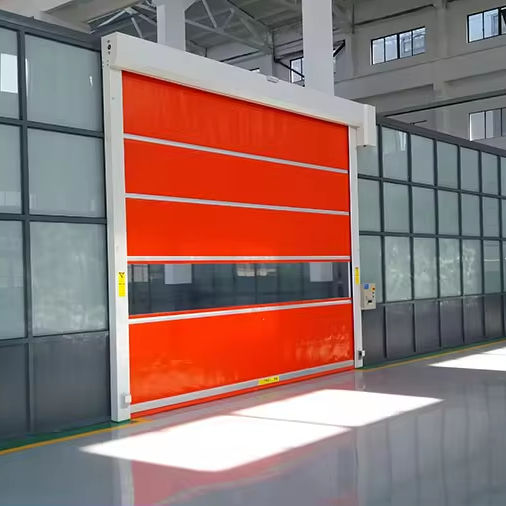 Industrial Self-Repairing Zipper PVC High-Speed DoorVIEW PRODUCTS