
Anjie Door Solution
Temperature Control Door Solutions
Factories, food processing plants, refrigerated warehouses, cold rooms, pharmaceutical facilities, logistics centers and temperature-controlled production areas need entrance systems that balance thermal separation with efficient movement. Anjie Door temperature control door solutions are designed around temperature difference, traffic frequency, opening size and environmental requirements.
Key Challenges
Maintaining stable temperatures between different industrial areas can be difficult when doors open frequently or do not provide sufficient insulation and sealing.
Frequent Door Opening
Repeated traffic can expose the opening for long periods and disturb stable conditions between zones.
Poor Insulation and Sealing
Insufficient panel insulation or weak perimeter sealing can allow heat transfer, cold-air loss and warm-air infiltration.
Airflow and Humidity Differences
Adjacent production, storage, chilled and frozen zones may have different temperature and humidity requirements.
Traffic Versus Thermal Separation
Doors must protect controlled conditions while still allowing forklifts, vehicles, people and materials to move efficiently.
Our Solution Strategy
Reduce Door-Open Time
At high-frequency entrances, operating speed can be as important as insulation because a heavily insulated door still loses control while open.
Improve Thermal Insulation
Use insulated sectional doors, rigid spiral doors, cold storage doors or freezer doors where temperature difference and closed-door performance are the main concerns.
Improve Perimeter Sealing
Review side edges, top seals, bottom seals, panel joints, frames and guide systems as one complete sealing system.
Automate Opening and Closing
Radar sensors, pull cords, remotes, push buttons, loop detectors and access control can help doors open only when required and close after traffic passes.
Recommended Door Systems
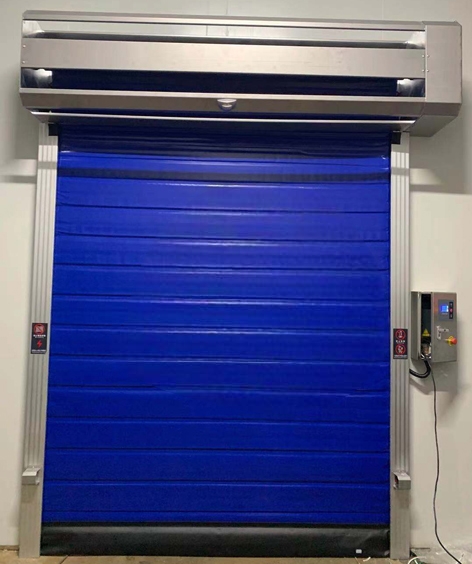
High Speed PVC Doors
Ideal for frequently used internal entrances where rapid separation between different temperature zones is required.
- Production areas
- Warehouse passages
- Food factories
- Packaging areas
- Internal logistics routes
- Conditioned workshops
Rigid High Speed Spiral Doors
Where fast operation needs insulated rigid panels, rigid spiral doors provide stronger thermal performance and security than flexible PVC curtains.
- Exterior factory entrances
- Temperature-controlled warehouses
- Automotive facilities
- High-frequency industrial entrances
Industrial Sectional Doors
Insulated sectional doors are commonly used where temperature control matters but opening frequency is moderate.
- Warehouse entrances
- Loading bays
- Industrial workshops
- Distribution centers
- Conditioned storage facilities
Cold Storage Doors
Cold rooms and freezer rooms require specialized insulated doors designed for larger temperature differences.
- Hinged cold room doors
- Sliding cold storage doors
- Manual sliding freezer doors
- Electric sliding cold storage doors
- Automatic refrigeration doors
Typical Applications
Manufacturing Plants
Factories may contain production areas operating at different temperatures, and high-speed doors can separate these zones without interrupting forklift traffic.
Food Processing Facilities
Ambient, chilled, frozen, processing and packaging zones may require different door systems according to temperature and hygiene needs.
Cold Storage Facilities
Cold rooms and freezers require high insulation and effective sealing, with automatic or high-speed systems for frequent entrances.
Warehouses and Logistics Centers
Conditioned warehouses may use insulated sectional doors at exterior entrances and high-speed doors for internal traffic routes.
Pharmaceutical and Controlled Facilities
Temperature-sensitive storage and production areas may require reliable separation coordinated with HVAC and environmental control.
How to Choose
Define Temperature Conditions
Confirm the temperature on each side of the door, the temperature difference and approximate humidity.
Review Traffic Frequency
Check whether the opening is used by personnel, forklifts, vehicles or automated equipment and how often it operates.
Balance Speed and Insulation
Use high-speed doors to reduce exposure time and insulated systems where closed-door thermal performance is more important.
Consider Interlocking
Selected controlled facilities can use two-door interlocking logic so both entrances do not remain open at the same time.
Recommended Door by Application
Frequent Internal Traffic + Moderate Temperature Difference
Use a high speed PVC door where exposure time is the main issue.
Frequent Traffic + Insulation Required
Use a rigid high speed spiral door where fast operation and insulated rigid panels are both needed.
Exterior Entrance + Moderate Traffic
Use an insulated industrial sectional door for closed-door thermal performance and large access.
Cold Room or Freezer Room
Use hinged, sliding or automatic cold storage doors with suitable anti-frost configuration where required.
High-Frequency Cold-Chain Entrance
Use automatic or high-speed cold storage entrance solutions where chilled or frozen routes are busy.
Why Anjie Door
Anjie Door provides configurable industrial door solutions for project-specific requirements.
Clear Solution Positioning
Temperature Control focuses on maintaining stable environmental conditions, while Energy Saving focuses on reducing energy loss and Cold Storage focuses on cold-chain door systems.
Multiple Door Technologies
High speed PVC doors, rigid spiral doors, insulated sectional doors, cold storage doors and freezer doors can be matched to different zones in the same facility.
Controls and Safety
Automatic operators, sensors, access controls, interlocking systems and safety devices can be selected according to traffic and environmental requirements.
Related Applications
Related Solutions
FAQ
How is Temperature Control different from Energy Saving?
Temperature Control focuses on maintaining stable environmental conditions between zones. Energy Saving focuses more broadly on reducing unnecessary heating or cooling losses and improving building efficiency.
How is Temperature Control different from Cold Storage?
Temperature Control covers many industrial temperature-separated areas, while Cold Storage focuses specifically on cold rooms, freezer rooms and cold-chain door systems.
Which door is best for frequent internal temperature-separated routes?
A high speed PVC door is often suitable when the main need is reducing open time at frequent internal traffic routes.
Request a Temperature Control Door Solution
Provide the temperature on each side, opening dimensions, humidity, traffic frequency and operating requirements so Anjie Door can recommend an appropriate temperature control door solution.
- Opening dimensions
- Temperature on each side
- Approximate humidity
- Daily operating frequency
- Personnel or forklift traffic
- Indoor or outdoor installation
- Required opening speed
- Insulation requirements
- Project location